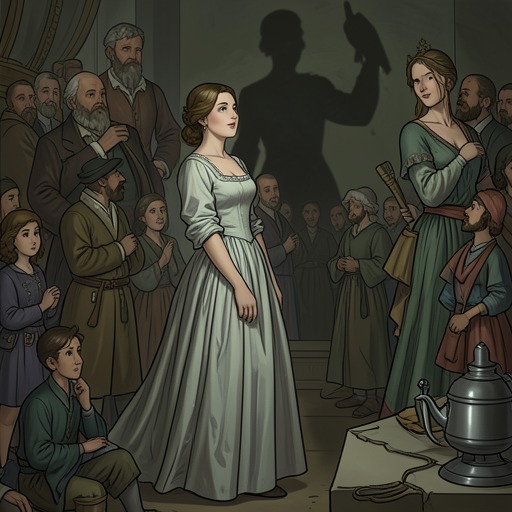
Esther risks appearing before the king to plead for the Jews
Book of EstherEsther’s approach to Ahasuerus without a summons is a decisive act of intercession for the Jews, undertaken when the law made an uninvited appearance in the king’s inner court punishable by death. The episode turns on a stark reversal: Esther, who had not been called into the king’s presence for thirty days, risks her life before a ruler whose favor cannot be presumed. She is received warmly rather than condemned, but the exposition treats the danger, her hesitation, the fasting, and the king’s response as parts of a larger providential design—not as events that cancel the responsibility of the people whose choices bring them about.
The danger and the stakes
The immediate danger is legal as well as personal. Anyone, man or woman, who entered the inner court without being summoned faced death unless the king held out his golden sceptre. Esther’s absence from the king’s presence for thirty days made the risk especially acute: the exposition argues that she could reasonably fear not only a capricious response but also the cooling of his affection. The law left the decision to the ruler’s momentary favor, and Esther had no assurance that being queen would protect her.
Her position compounded the danger. In approaching Ahasuerus on behalf of the Jews, she would appear not merely as a queen but as a captive Jewess belonging to the people condemned under Haman’s decree. The exposition observes that a despot’s affections might not be trusted to outweigh political calculation, and that Esther could fear her death might simply clear the way for a successor. The king’s earlier willingness to discard Vashti supplies a further measure of the insecurity of Esther’s royal standing.
The episode also belongs to a history of wrongdoing. The exposition regards Esther’s elevation through the king’s choice of a queen, and the circumstances following Vashti’s removal, as contrary to God’s law. It therefore refuses to make the eventual good outcome a justification of the conduct that preceded it. In its account, God’s purpose to deliver the Jews is accomplished through human actions that remain sinful and accountable.
Mordecai’s appeal and Esther’s decision
At first Esther refuses Mordecai’s request that she go to the king. The exposition interprets that refusal as fear prevailing over her concern for her people, and notes that Esther seems to have counted on safety in the palace while the decree threatened the Jews outside it. Mordecai’s warning strips away this confidence: she should not imagine that the king’s house will shelter her from the fate of the rest of her people. If she stays silent, he tells her, deliverance for the Jews will arise from another place, while she and her father’s house will face destruction.
Mordecai’s argument joins urgency to faith. He expects that the Jews will be delivered, but does not treat that confidence as a reason to do nothing. He points to Esther’s royal position as an opportunity that may have been given for this very crisis, asking whether she has come to the kingdom for such a time. The exposition sees this as an interpretation of events that could also be explained in ordinary human terms: Esther’s rise followed Vashti’s removal and her own beauty, yet Mordecai understands her position as providentially placed at the service of the threatened people.
The warning changes Esther’s course. The exposition presents Mordecai’s admonition as a means of recovering a servant of God from a false sense of security: she is brought from timidity to a willingness to accept death rather than abandon her duty. Her resolution, If I perish, I perish, marks the moment when she has counted the cost. The narrative’s appeal is not that danger has disappeared, but that she will act despite it.
Fasting and the unsummoned approach
Before Esther enters the court, she orders the Jews gathered in Shushan to fast for her for three days, night and day. She and her maidens will fast as well. This preparation gives the intercession a communal setting: Esther does not approach as if her rank alone can secure the outcome, and the people facing the decree join in seeking help before she undertakes the dangerous service.
The exposition draws a distinction between reliance on God and the use of human means. Mordecai has faith that deliverance will come, yet he appeals to Esther’s influence; Esther, in turn, fasts and then goes to the king. Confidence in providence does not make action unnecessary. Rather, the account presents vigilance, prudence, and effort as means through which deliverance may be sought, while insisting that ultimate confidence rests in God.
On the third day Esther puts on her royal apparel and stands in the inner court, opposite the king’s house. Ahasuerus is seated on his throne in the royal house, facing the gate. The scene places the danger in a concrete gesture: Esther has crossed the boundary she was forbidden to cross without a summons, and now the king’s response will determine whether she lives. The exposition emphasizes that her risk was real, not a danger that later readers should dismiss by judging from the customs of their own country.
The king’s favor and Esther’s delay
Ahasuerus sees Esther, she finds favor in his sight, and he holds out Ahasuerus’s golden sceptre. Esther draws near and touches its tip. The gesture that could have been withheld becomes permission to live and approach. The king asks what she wants and offers to grant her request up to half the kingdom. His reception reverses the coldness implied by the preceding thirty days: instead of the feared sentence of death, Esther encounters exceptional warmth and generosity.
The exposition describes the favor as genuinely arising in the king’s own heart while also attributing it to God’s rule over human decisions. It does not treat Ahasuerus as a puppet whose action ceases to be his own. Rather, the king freely responds with favor, while that response also serves a purpose beyond his own intention. The same account of providence that preserves human agency therefore gives particular weight to the moment when the sceptre is extended.
Esther does not immediately disclose her request. She delays not only in the first encounter but also at the first banquet. The exposition notes that she might have seemed to have good reason to speak while the king was favorably disposed, and that suspense could have made an immediate appeal attractive. It nevertheless reads the delay as allowing Haman’s part in the unfolding reversal to continue. Before his downfall, he is to rise further into self-importance; the gallows he prepares for Mordecai will ultimately become his own place of execution. Esther’s pause thus prolongs the peril and the dramatic reversal rather than ending the crisis at the moment of her safe reception.
Providence, responsibility, and the episode’s meaning
The episode is used to illustrate the exposition’s central claim that God’s providential purpose and human freedom are not mutually exclusive. Esther chooses whether to approach; Mordecai deliberately urges her; Ahasuerus responds according to his own disposition. These actions are not described as unreal or involuntary. At the same time, the exposition sees Esther’s position, her decision, and the king’s favor as serving a divine purpose in the threatened Jews’ deliverance.
That interpretation does not absolve wrongdoing. The exposition insists that God has no share in human guilt, and that the good brought through sinful conduct does not make the conduct lawful. It applies the same distinction to Esther’s earlier situation and to the broader sequence of events: divine appointment may bring good out of human evil without turning the evil into obedience. In this reading, providence is not a moral excuse for the actors but an account of how their freely chosen actions can be made to serve an end they do not control.
The event also gives practical force to the exposition’s teaching about obedience. Esther’s royal rank does not guarantee safety, and the path to duty is not made harmless before she takes it. The account uses her willingness to risk her life to challenge confidence in status and to argue that a person should not withhold an available means of service merely because the outcome is dangerous. Yet it presents her action alongside fasting and dependence on God, not as self-reliant heroism. The sceptre’s extension completes the scene’s immediate reversal: Esther enters under sentence of possible death and is received with favor, while the larger appeal remains poised for what follows.